
 Price: from €1,050
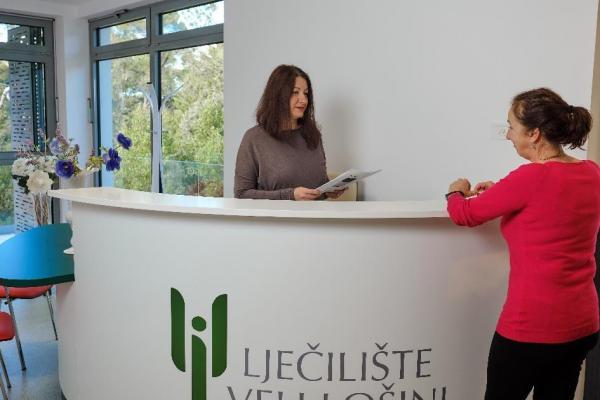
Lječilište Veli Lošinj - Health Center Veli Losinj
Health Center Veli Losinj is clinic which provides health programs with accomodation and touristic services. Health programs include pulmonary rehabilitation, asthma rehabilitation, atopic dermatitis treatment, psoriasis treatment and programs with clasic physical therapy. We combine medical service with natural healing factors that are unique for our islands.
Croatia
4,986
Views
No awards
BookingsMed
Modern clinic
State of the art equipment and advanced technology.
Safe & reliable
Highest standards of hygiene and patient safety.
Patient first
Personalized care and dedicated support every step of the way.
24/7 support
Our team is here for you at any hour.
Our services
- Pulmonary rehabilitation Breathe health on Lošinj - pulmonary rehabilitation program By staying on the island of Lošinj, you are exposed to a 24-hour inhalation therapy with a unique aerosol enriched with sea salt and essential oils of hundreds of medicinal plants of the island. 130 years ago, Austrian doctors recognized the island of Lošinj as a place where the Latin proverb "Medicus curat, natura sanat" or "Doctor cures, nature heals" confirms its millennial truth. At the Veli Lošinj Health Center, we carry out a pulmonary rehabilitation program under the supervision of a pulmonologist and according to clinically recommended guidelines. The program itself is individualized in accordance with the results of pulmonary examination and diagnostics and consists of breathing exercises, exercises for the upper and lower extremities, training of respiratory muscles on medical devices and other therapeutic procedures. The recommended duration of the program is 12 days and includes: - examination by a pulmonology specialist - diagnostics of pulmonary functions (diffusion for CO, spirometry, 6-minute gait test) - rehabilitation according to the individual program - nutritionist counseling - final examination by a pulmonologist and final test (spirometry and 6-minute gait test) - accomodation in Villa Elisabeth in double room with halfboard - 12 days From €1,050
VELI LOŠINJ SPA
The beginnings of the Veli Lošinj Spa are recorded almost 130 years ago, when in the summer of 1885, on his Adriatic cruise, Archduke Karlo Stjepan Habsburg, commander of the Austro-Hungarian navy, chose Veli Lošinj as the most suitable place for his vacation, due to the beauty of the landscape, vegetation and extremely favorable climatic conditions. He bought land and built his residential summer house/winter house, the villa "Wartsee" and built a large garden next to it, which was completed in 1890. In 1886, work began in the port of Rovenska, when Austrian Archduke Maximilian of Habsburg, younger brother of Emperor Franz Joseph I, admiral of the Austrian Navy and later Emperor of Mexico, laid the foundation stone for the construction of the breakwater. From Rovenska to Uvala Kriška, there is a coastal road about 3 km long.
In 1889, Villa "Wartsee" was turned into a public climatic health resort, that is, a hospital for children's diseases (for scrofulous and feeble-minded children...).
Three years later, in September 1892, at the suggestion of Dr. Conrad Clara, pioneer of health tourism on Lošinj and assistant professor of balneology in Graz, and Dr. Leopold Schrötter, professor at the Vienna Medical School and specialist in lung and throat diseases, the Austro-Hungarian Ministry of Health officially declared Veli Lošinj a "climatic health resort". Lovran was declared a climatic health resort in 1898, Opatija in 1899, and Crikvenica in 1906.
Since 1893, the spa commission of the Austro-Hungarian Ministry of Health published data on the total number of guests on Lošinj, according to which 1,566 guests stayed in 1899, 8,427 in 1913, and 5,816 guests in 1914.
Since then, the spa has changed its owner and purpose several times. As a medical institution, a children's hospital and a spa, it has been operating continuously since 1957, during which time it has gained a reputation here and around the world as a spa specializing in the treatment of respiratory tracts, asthma, allergies and psoriasis, as well as physical medicine and rehabilitation.
According to the classification of the spa, it is a climatic spa because it bases its spa programs on the convenience of the natural conditions at the location; a mild Mediterranean climate characterized by a large number of sunny hours throughout the year, above all clean sea and air, and large complexes of pine forest and Mediterranean vegetation at the very location of the spa and in the surrounding area.
PARK-FOREST UNDER JAVARI
Pod Javori forest stretches on the slopes of Kalvarija hill, from the existing road and the chapel of St. Ivan to the road to Veli Lošinj and to the spa area.It is protected as a natural value, park-forest, based on the Decision on the declaration of the area "Under Javori" in Veli Lošinj as a "forest park", "Fig. n. Municipality of Cres-Lošinj" number 1/1993.
Here, Archduke Karlo Stjepan Habsburg arranged a garden next to his summer house designed by Viennese garden experts. About 200 species of different conifers and exotic plants were planted as part of the landscape composition, walkways were arranged, a fence was built and an irrigation system was built, which ensured the rapid progress of the plants. It consisted of a water reservoir built at the highest elevation, which was filled with pumps from a well (built in 1763) located at the foot of the meadow where there was an inexhaustible source of water at 15 m, and a system by which the water was distributed by gravity to all areas of the meadow.
Traces of the original parkland from the 19th century have been preserved, which show the high aesthetic value of the park's composition; parts of the paths, fence wall and park vegetation, as well as the non-functioning water reservoir.
The park outside the narrow area of the health resort is not maintained, and the plant stock mainly consists of overgrown autochthonous vegetation and Aleppo pine.
SPATIAL ENVIRONMENT
The area of the Town of Mali Lošinj as a tourist destination has recorded 120 years of development in health and spa tourism.It is rich in extraordinary natural resources, islands and islets of the Lošinj archipelago, agricultural areas, attractive landscapes, mild climate, clean sea and environment, diverse Mediterranean vegetation, forest parks, zoological reserves and natural monuments.
The cultural and historical heritage is another great wealth of this area, dating back to prehistory in continuity through all historical periods, the historical units of Osor and Mali and Veli Lošinj stand out, numerous sacred buildings, castles, shepherds' apartments, tourist villas from the end of the 19th and beginning of the 20th century. etc.
The location of the spa in Veli Lošinj, near the central resort of Mali Lošinj and within the Malošinj archipelago as a highly positioned tourist destination on the "island of vitality" opens up countless benefits, of which the following are particularly important for the functioning of the spa:
- mild climate with outdoor swimming season that lasts from May to October,
- large areas of pine forests and autochthonous vegetation ,
- natural beauty, values and peculiarities of the Malošinj archipelago , especially those included in the 250 km of hiking trails and cycling routes, the contact area of the cultural landscape on the slope at the foot of St. John to St. Nicholas,
- preserved environment , above all the quality of the air and the coastal sea,
- the existing organized beaches in the immediate vicinity , the distance of the spa from the sea is approximately 850 m to Punta beach and the same distance from Rovenska beach and 1,620 m to Javorna beach,
- existing tourist accommodation, catering, sports and recreation facilities , wellness and swimming facilities in the surrounding area, especially those in Punta hotels in Veli Lošinj and in Mali Lošinj in hotels on Čikat and Sunčana Uvala,
- cultural and historical monuments and cultural events on the islands ,
- Veli and Mali Lošinj and other historic settlements on the islands with their ambient peculiarities and central facilities that include public cultural, religious, hospitality, service and other facilities,
- agriculture, an activity within the Malošinj archipelago, focuses on the production of healthy, organic, ecologically grown food that is marketed in the island's catering industry, as well as fishing and shellfish farming, also as a source of healthy food.
At the Veli Lošinj Spa, a large number of local and foreign guests combine the pleasant with the useful, so in addition to the benefits of the microclimate, the sun and the sea, they also use medical rehabilitation services under the supervision of a specialist in physical medicine and rehabilitation, a specialist in dermatovenerology and a specialist in pulmonology.
NATURAL MEDICINAL AGENTS FROM LOŠINJ
The climate on the island of Lošinj is mild Mediterranean with 2,631 sunny hours per year or an average of 7.2 sunny hours per day. Lošinj is far enough from the mainland that the continental climate has no effect on the island's microclimate. The average annual temperature is 15.6 °C, and there are almost no temperatures below zero in winter. The warm sea current along both sides of the island acts as a natural regulator of island temperatures and causes small daily fluctuations in maximum and minimum air temperatures, which are the lowest in winter in December (4.2 °C) and the highest in summer in July (8.1 °C). .
The sea around the island of Lošinj is of high quality due to its transparency and the absence of harmful substances. Its average temperature ranges from a low of 11.8 °C in February to 23.6 °C in August. It has a beneficial effect on the human body, relaxes and calms it down. Lošinj offers the possibility of swimming along its entire coast, and several beaches in Lošinj boast the Blue Flag.
Clean air has become a symbol of quality of life. The air on the island of Lošinj is of excellent quality, ideal humidity and temperature. We find floating particles in the air of Lošinj only in traces, as well as admixtures of sulfur dioxide and carbon monoxide. Air quality has improved in the last fifteen years, as measures to control the biggest pollutants on land have been tightened, and unleaded gasoline has been introduced into circulation. High air currents and winds clean the air as well as a large amount of precipitation. In addition, the air is enriched with sea aerosol and dispersed drops of essential oils of aromatic plants. Breathing in this fragrant, clean air refreshes the lungs, makes breathing easier, and creates a feeling of comfort and good mood.
Croatia
Get directions- Breathing System
Suggested clinics
 Dentelli
Split, Croatia
5.0
View profile
Dentelli
Split, Croatia
5.0
View profile
 A2 Dental
Trogir, Croatia
5.0
View profile
A2 Dental
Trogir, Croatia
5.0
View profile
 Denti Croazia
Zagreb, Croatia
5.0
View profile
Denti Croazia
Zagreb, Croatia
5.0
View profile
 Adriatic Dent
Rovinj, Croatia
5.0
View profile
Adriatic Dent
Rovinj, Croatia
5.0
View profile
 DENTAL MEDICINE CENTAR ORTO - NOVA
Rijeka, Croatia
5.0
View profile
DENTAL MEDICINE CENTAR ORTO - NOVA
Rijeka, Croatia
5.0
View profile
 Regenius
Zagreb, Croatia
5.0
View profile
Regenius
Zagreb, Croatia
5.0
View profile
 Bizovacke toplice Physical Therapy and Robotic Neurorehabilitation center
Bizovac, Croatia
5.0
View profile
Bizovacke toplice Physical Therapy and Robotic Neurorehabilitation center
Bizovac, Croatia
5.0
View profile
 Terme Sveti Martin
Sveti Martin, Croatia
5.0
View profile
Terme Sveti Martin
Sveti Martin, Croatia
5.0
View profile
 Thalassotherapia Opatija
Opatija, Croatia
5.0
View profile
Thalassotherapia Opatija
Opatija, Croatia
5.0
View profile
 Terme Tuhelj
Tuheljske Toplice, Croatia
5.0
View profile
Terme Tuhelj
Tuheljske Toplice, Croatia
5.0
View profile

